The 2026 PGA Championship delivered four days of attritional, compelling golf at Aronimink Golf Club, where thick rough, slick greens and punishing pin positions ensured nobody could pull away from the field until late on Sunday afternoon.
The course conditions were central to the drama. Aronimink was set up with a classic PGA Championship edge: fairways that looked generous from the tee but became claustrophobic once the rough swallowed approach angles. Players repeatedly struggled to control spin into the firm greens, and the leaderboard reflected that uncertainty. Scores fluctuated wildly all week. A birdie run could suddenly become a double-bogey spiral, and even the world’s best looked tentative over short putts as the pressure mounted.
A crowded leaderboard
Sunday began with a remarkably congested leaderboard. More than 20 players remained within striking distance entering the final round, including major champions Rory McIlroy, Jon Rahm, Justin Thomas and defending champion Scottie Scheffler. Even approaching the turn, it still appeared impossible to predict a winner. Aaron Rai himself looked to be drifting after a couple of early mistakes left him three shots off the pace.
Then came the decisive stretch on the back nine.
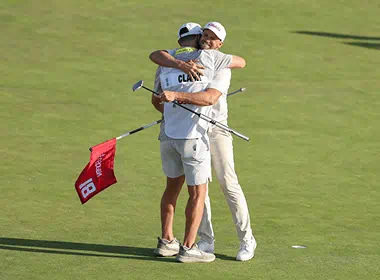
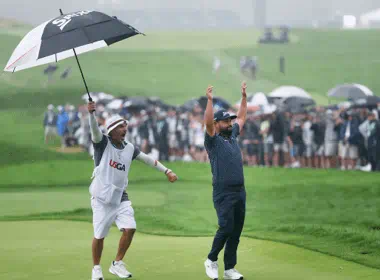
Rai’s composure separated him from the chaos around him. His eagle on the ninth reignited momentum, but it was the precision of his iron play from the 11th onwards that truly broke the championship open. While Rahm, McIlroy and others struggled to maintain rhythm on Aronimink’s brutal closing stretch, Rai kept attacking. Birdies at 11, 13 and 16 suddenly created daylight, before a spectacular long-range birdie putt on 17 effectively sealed the Wanamaker Trophy.
By the time he walked up the 18th fairway, the previously jammed leaderboard had finally thinned. Rai closed with a brilliant 65 to win his first major championship by three shots.
A new British major champion
Rai’s victory carried historical significance beyond the trophy itself. He became the first English winner of the PGA Championship since Jim Barnes in 1919 - ending a wait of more than a century.
It was a fitting finish to a championship defined by volatility. For three days and nine holes, the field refused to separate. Then, under the greatest pressure of his career, Aaron Rai produced the calmest golf of anyone in the tournament. That is often how majors are won: not with dominance from start to finish, but with flawless execution when everyone else begins to unravel.